ItôFormer: Augmenting Stochastic Validity in Financial-centric Deep Neural Networks
DOI: dx.doi.org/10.2139/ssrn.6742840
Quantitative Research · Machine Learning · Financial Mathematics

Nathaniel Coulter is a quantitative researcher at Columbia University whose work focuses on machine learning, quantitative finance, market microstructure, and algorithmic trading. He founded and managed Coulter Capital Management, a quantitative hedge fund focused on automated trading and equity derivatives…
Open Profile →



Selected papers, working research, and technical notes across quantitative finance and machine learning.
Papers · Models · Technical Notes
Quantitative investment fund focused on market microstructure, algorithmic trading, and equity derivatives. AUM: $100M+.
Quantitative Investment Fund
Selected privacy and security-oriented software work.
Chrome Extension
Selected machine-learning and assistant-system development.
Desktop Application
Alpha models, data sources, trading algorithms, feature-engineering notes, and retired systems with educational or research value.
Models · Data · Algorithms
Community involvement, charitable work, and selected initiatives supported through personal and Coulter Capital resources.
Community · Service · GivingSelected historical records, photographs, and earlier work.
Records · Media · Chronology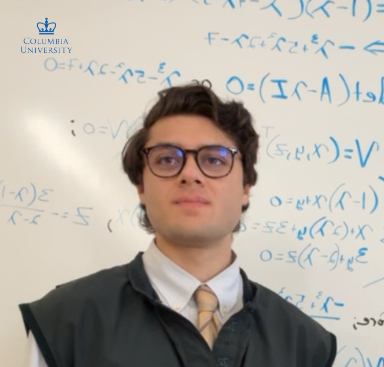

Nathaniel Coulter is a quantitative researcher at Columbia University whose work focuses on machine learning, quantitative finance, market microstructure, and algorithmic trading. He founded and managed Coulter Capital Management, a quantitative hedge fund focused on automated trading and equity derivatives. His academic research includes transformer architectures for financial time series, neural portfolio allocation, and cross-asset quantitative modeling. Coulter holds a B.S. in Financial Mathematics with a minor in Data Science and an M.S. in Finance from St. John’s University, and is currently a postgraduate researcher at Columbia University in New York. He also speaks Mandarin Chinese and Italian, in addition to his native English. Prior to founding Coulter Capital Management, he studied under Dr. James Watson at Cold Spring Harbor Laboratory. His interests outside of academia and industry include reading, golf, chess, guitar, and philanthropy.
DOI: dx.doi.org/10.2139/ssrn.6742840
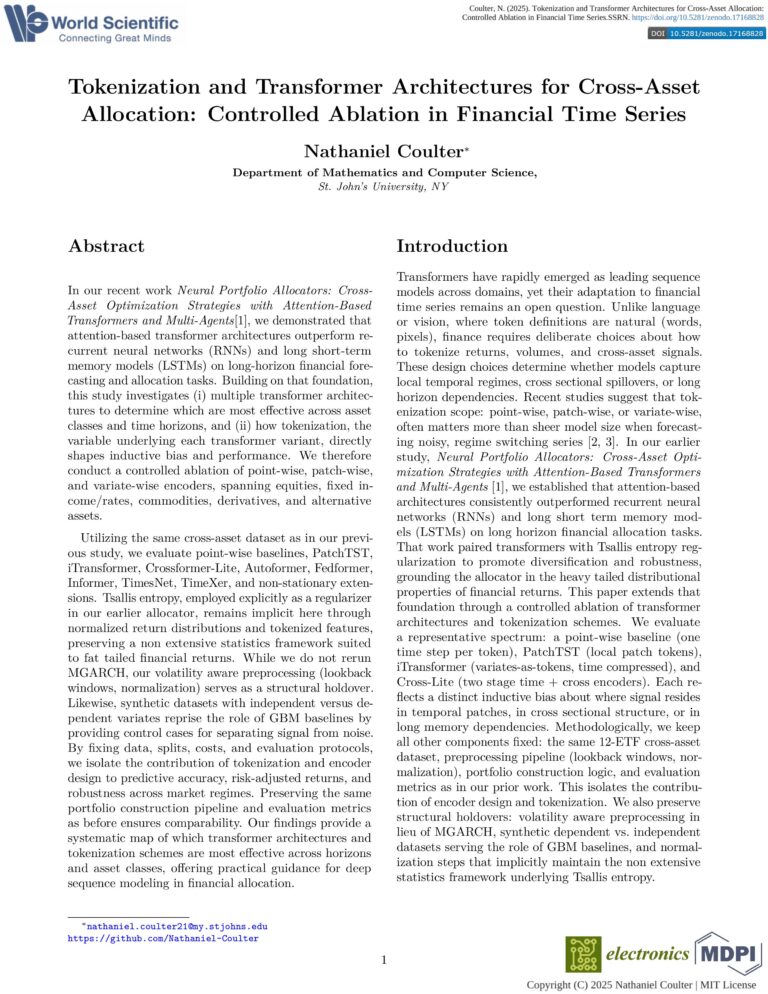
DOI: dx.doi.org/10.2139/ssrn.6934938
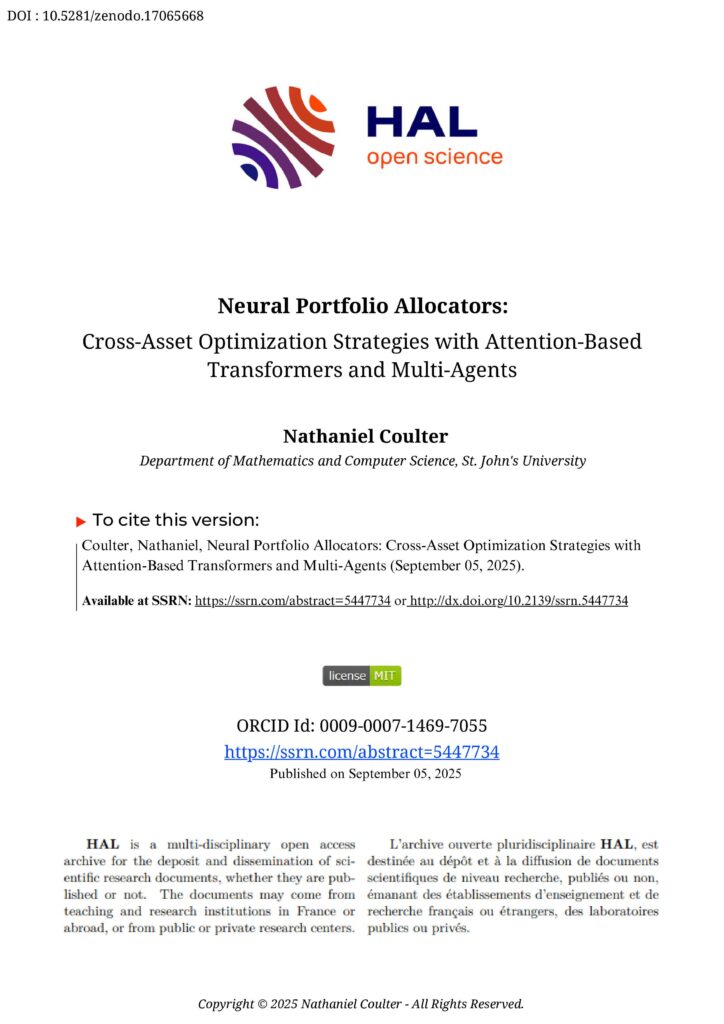
DOI: dx.doi.org/10.2139/ssrn.5447734
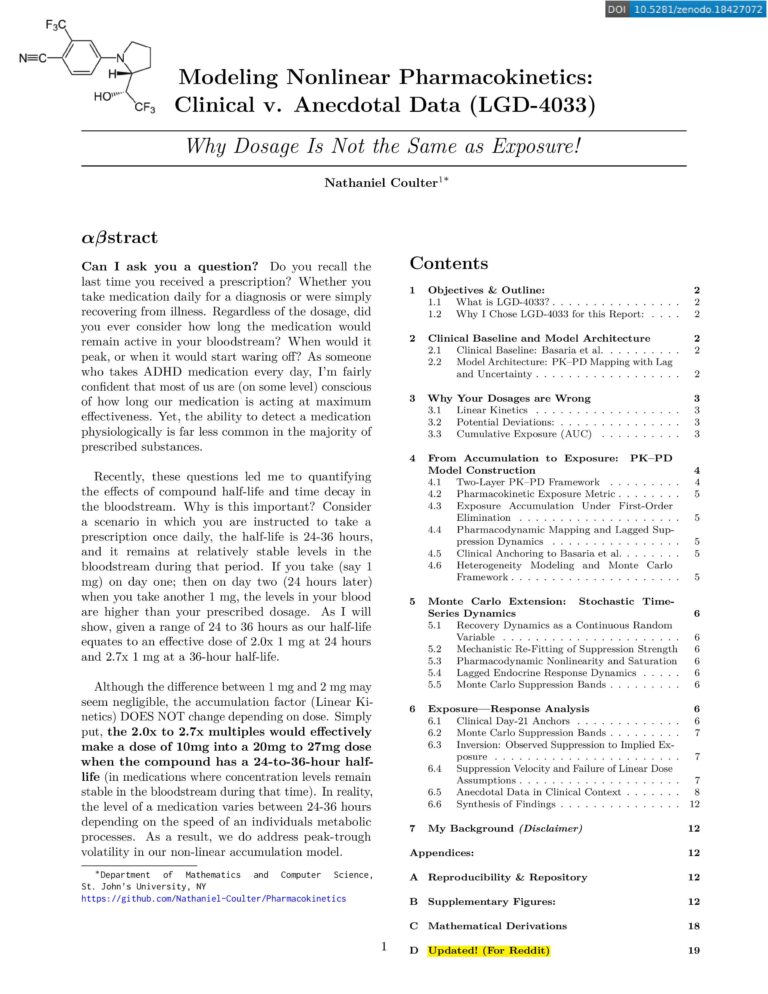
DOI: dx.doi.org/10.2139/ssrn.6934521
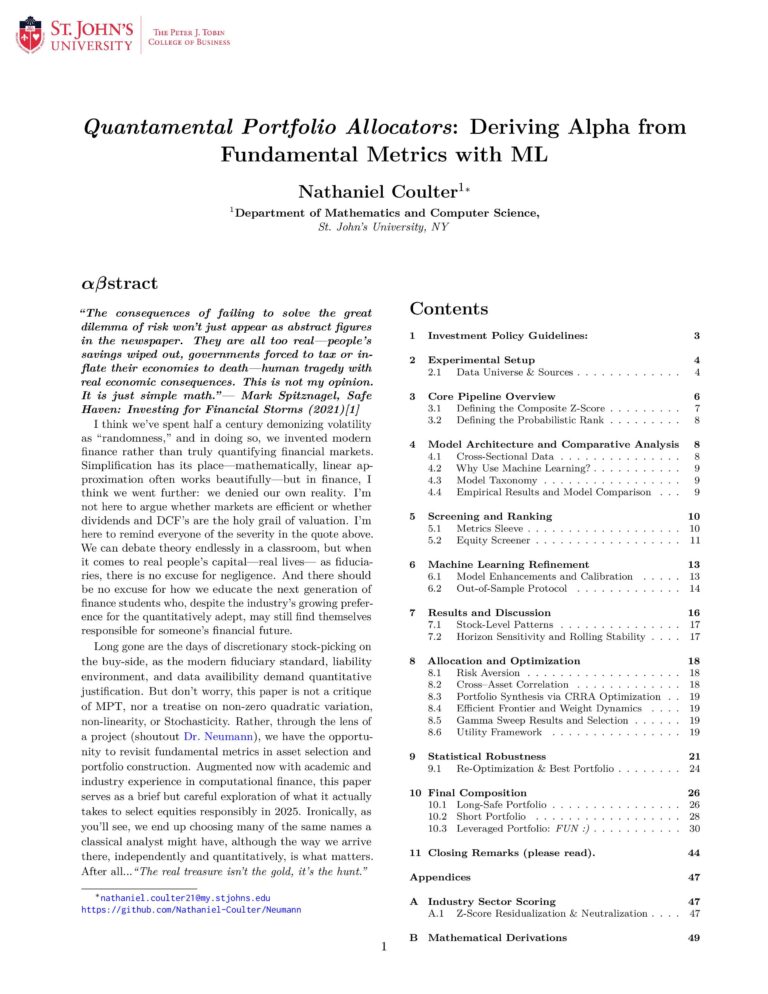
DOI: doi.org/10.2139/ssrn.6934778
Embedded document viewer · browser-native PDF controls

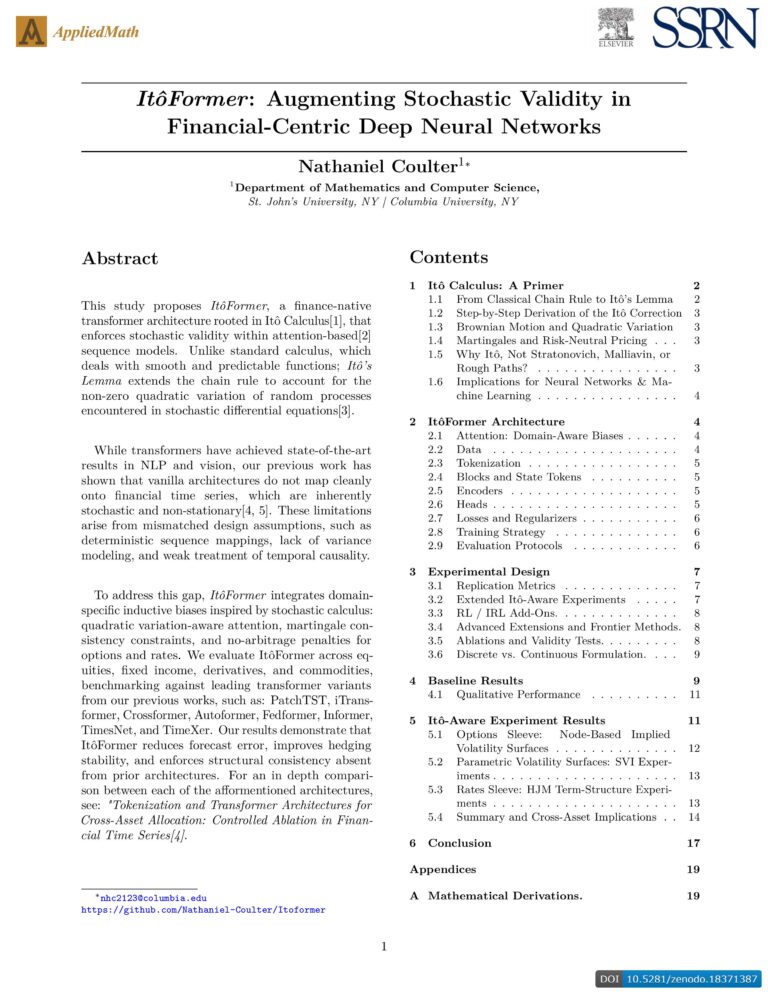
This study proposes ItôFormer, a finance-native transformer architecture rooted in Itô Calculus[1], that enforces stochastic validity within attention-based[2] sequence models. Unlike standard calculus, which deals with smooth and predictable functions; Itô's Lemma extends the chain rule to account for the non-zero quadratic variation of random processes encountered in stochastic differential equations[3].
While transformers have achieved state-of-the-art results in NLP and vision, our previous work has shown that vanilla architectures do not map cleanly onto financial time series, which are inherently stochastic and non-stationary[4, 5]. These limitations arise from mismatched design assumptions, such as deterministic sequence mappings, lack of variance modeling, and weak treatment of temporal causality.
To address this gap, ItôFormer integrates domain specific inductive biases inspired by stochastic calculus: quadratic variation-aware attention, martingale consistency constraints, and no-arbitrage penalties for options and rates. We evaluate ItôFormer across equities, fixed income, derivatives, and commodities, benchmarking against leading transformer variants from our previous works, such as: PatchTST, iTransformer, Crossformer, Autoformer, Fedformer, Informer, TimesNet, and TimeXer. Our results demonstrate that ItôFormer reduces forecast error, improves hedging stability, and enforces structural consistency absent from prior architectures. For an in depth comparison between each of the afformentioned architectures, see: "Tokenization and Transformer Architectures for Cross-Asset Allocation: Controlled Ablation in Financial Time Series[4].
Stochastic Calculus, Financial Machine Learning, Transformer Models, Quantitative Finance, Financial Engineering, Financial Mathematics, Neural Stochastic Differential Equations, Neural Networks, Deep Neural Networks, Machine Learning, Applied Machine Learning, Applied Mathematics, Itô Calculus, Itô's Lemma, Time Series Forecasting, Deep Learning for Finance, Arbitrage-aware Modeling, Martingale Constraints, Martingale Consistency, Volatility Surface Modeling, Implied Volatility Modeling, Neural SDEs, Stochastic Differential Equations, Financial Time Series, Attention Mechanisms, Stochastic Processes, No-arbitrage Regularization, Options Pricing, Computational Finance
C45, C53, G17, G12, C63, G13, C02, C58, E43
The author declares no competing financial interests, commercial affiliations, or personal relationships that could have appeared to influence the work reported in this paper.
This study did not involve human subjects research, clinical interventions, patient recruitment, or access to protected health information. All clinical data were obtained from publicly available published literature, and anecdotal observations were derived from publicly available self-reported sources that were anonymized and analyzed in aggregate for educational and research purposes. Accordingly, institutional review board (IRB) approval was not required.
This research received no external funding and was conducted independently by the author.
The copyright holder has granted SSRN a license. All rights reserved. No reuse allowed without permission.
MIT License
Copyright (c) 2025 Nathaniel Coulter
Permission is hereby granted, free of charge, to any person obtaining a copy of this
software and associated documentation files (the "Software"), to deal in the Software
without restriction, including without limitation the rights to use, copy, modify,
merge, publish, distribute, sublicense, and/or sell copies of the Software, and to
permit persons to whom the Software is furnished to do so, subject to the following
conditions:
The above copyright notice and this permission notice shall be included in all copies
or substantial portions of the Software.
THE SOFTWARE IS PROVIDED "AS IS", WITHOUT WARRANTY OF ANY KIND, EXPRESS OR IMPLIED,
INCLUDING BUT NOT LIMITED TO THE WARRANTIES OF MERCHANTABILITY, FITNESS FOR A PARTICULAR
PURPOSE AND NONINFRINGEMENT. IN NO EVENT SHALL THE AUTHORS OR COPYRIGHT HOLDERS BE LIABLE
FOR ANY CLAIM, DAMAGES OR OTHER LIABILITY, WHETHER IN AN ACTION OF CONTRACT, TORT OR
OTHERWISE, ARISING FROM, OUT OF OR IN CONNECTION WITH THE SOFTWARE OR THE USE OR OTHER
DEALINGS IN THE SOFTWARE.
Quantitative investment fund focused on algorithmic trading, market microstructure, and equity derivatives.
Visit Coulter Capital ↗
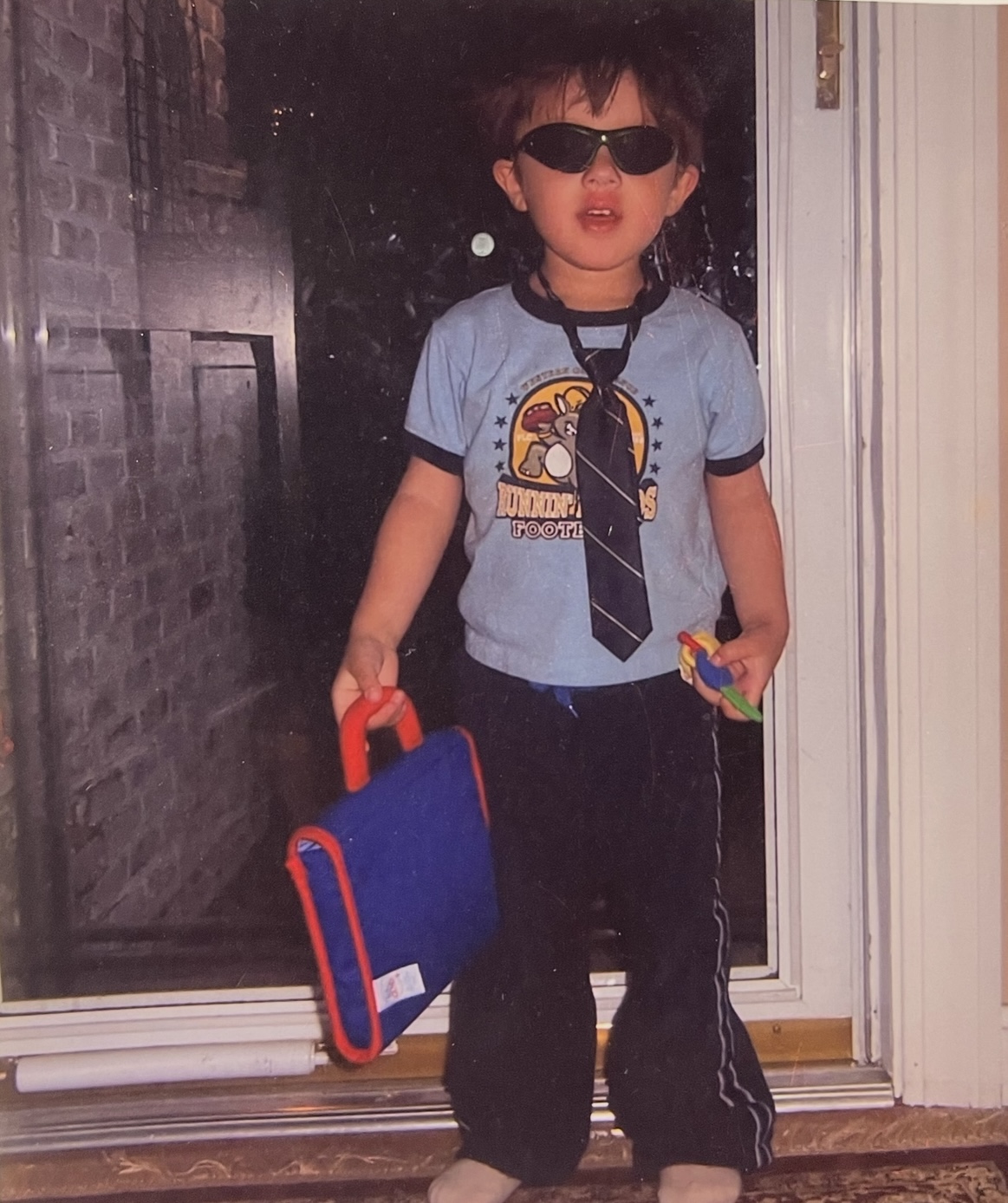
I’m going to ask you this same question again. So make note of whatever just came to mind. I have two answers to this question in all its forms, and I’ll usually choose depending on who’s asking. Both are true statements that answer the question while remaining personal to me. Neither provide the complete answer. Looking at the picture of me, yes, that’s me at age five. One might think I’ve always been destined for a career on Wall Street. After all, I had the briefcase, tie, etc. I’m not sure how many children view us as superhero’s now, but I’m glad to report at least one did in the past. As those of you with children likely assumed; I do have family in industry–no child dresses like that otherwise. Wait! Before your nepotism alarm bells start ringing—I won’t directly dispute that claim, you’ll be able to judge for yourself shortly. Now let's get back to the question!
Under no circumstances would I deny the allure of healthy compensation, that’s one of the few beautiful truities on Wallstreet. A single fair, direct reflection of performance. “Kill what eats you” or whatever the saying is. Without that allure, how else could you attract top tier talent away from cancer research? Despite the realities, evident to those who’ve sat on a trading desk for a single bonus season. I personally believe that your typical, well-educated, and aspiring young professional has far greater expectations surrounding compensation than the vast majority of jobs in financial services offer. I said “job” for a reason. “Career” carried the implication of security (only in wealth management is it possible to achieve such a feat). Along with misaligned expectations, there’s a distorted and romanticized perception of the prestige one acquires from uttering those cherished words: “I’m in finance”. The women know how ridiculous it sounds too, I know they have to put up with it (sorry). But it’s real, I see way to many kids going on incredible firms with zero psychological / philosophical depth behind them, aside from fallacies of seven figures out of college, and fantasies predicated on employment at a (insert bank/fund) increasing sex appeal. Trust me it doesn’t, I’ve tested it with friends who swing every direction because that’s what quants do at bars. She/he doesn’t know what Citadel is and if they do know Goldman & Morgan they think JPM is more prestigious anyway so you’ll just end up making yourself mad. I digress, so what’s my point? Simply put: If one was chasing a guaranteed income they’d be better off becoming a doctor, or a lawyer, or a slew of other careers that don’t get to say “I’m at (JPM)”… or GS/MS if you’re really good looking. So the question becomes: why not pick another prestigious career?
Here’s how I’d conceptualist that choice:
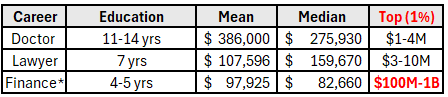
A career in finance inherently comes with the lowest potential salary relative to the other two high prestige careers. Tech was excluded deliberately, at least we get a little nostalgia in that fact. Albeit the extent of it is purely occupational, not technical given modern capital markets.
A Doctor studies for 10+ years and they’re done. For their trouble they get the highest salary “guaranteed” (statistically). We then have attorneys in school for the second longest. Whom demand the second highest salary, true, but it’s the trend we want to focus our attention to that’s being more important. Lawyers have to study for three years following undergrad, and aside from minor brush ups with changing legislation, the majority of being taught and subsequently learning new information is over post-law-school. Finance is the opposite… We are (effectively) REQUIRED to learn continually. To evolve, and drive ourselves to progress in our skills. There is never a “done learning”. Which leads us elegantly into our first answer.
Answer #1“I want to go into finance because I love learning for learning's sake, and there’s always a chance to chase those eight figure plus years if you end up in the right seat.
Takeaway: A true love for learning.
Janestreet calls it solving puzzles. As you may have noticed, I enjoy Chess (see NateBot). I don’t have as much of a passion for pure mathematical or logical problems anymore. Same goes for puzzles, and riddles that feel too unserious—mentally thinking about everything regardless but emotionally I feel worse walking away from a problem too unacademic when I could be solving another. I did in my youth, but nowadays if I have the mental capacity available and a desire to learn. I’d prefer devoting my energy too a traditional hard science like physics, or simply reading non-fiction, engineering (working on my car), or doing research on a subject I don't do professionally (ex: pharmacokinetics). Moral: You don’t have to fit into the stereotypical “Leetcode/ Puzzle Grinder” boxes to have a vigorous curiosity.
We don’t have to wait long to get my second answer. Recall the risk I spoke of earlier that one takes in financial services versus the other professions? Well, I undersold it a bit. You can actually lose money AND it's damn near a requirement if you’re in the position to make the top 1% numbers, that’s just how it goes. (Stop nitpicking: I’m not saying the risk is geometric, and my sentences assume most readers are constrained by the lack of awareness of arbitrages).
Nowhere is the risk of losses more crucial to your entire existence than actively managed (hedge) funds. Which ties back to the love for learning we have independently, on a much larger scale through competition. Seeking to get better, to gain that 0.01% edge over your competitors and at funds even against other pods of your disgustingly educated coworkers. Sure not everything is building alpha models, and hopefully any edge is not black like our old friends at SAC. But the competition between others is what drives us to be better than we probably could’ve been on our own. As you will see later I have tried to push myself and the pure “Love of Learning” to its most extreme, but it’s still not the same as competition that requires you to step up. It’s not about winning or losing, if we have a positive expectancy that we can define because we’re smart, a loss is meaningless, it's an opportunity to collect more data to optimize models. Winning can be equally as dangerous but in the end that’s not my point, I'm saying that emotions drive us to become the best versions of ourselves when viewed and channeled properly…
Answer #2“[yeah I love learning, but]... I would rather make $2 if they make $1, than make $1M if they make $2”.
Takeaway: At the end of the day it comes down to BOTH your competitiveness, discipline in other parts of life to be the best you can be for that little bit of edge; and love for learning of course.
Note: the main reason I’m sharing this is in the hopes it inspires introspection into your own journey, and true philosophy. The human brain is quite possibly, the single most amazing construction in existence. Anywhere in the cosmos, and we all have one in our heads! It’s sad how trendy it’s become not to use them more, it almost seems wasteful.
Ironic that neither of the two longwinded philosophical rants actually answer why I’m in finance. Ending up in finance was never what I had planned. In reality, my path was very nonlinear—and stochastic (to use some familiar vernacular). I always wanted to be an attorney growing up from around the time that picture of young me was taken all through high school.
Why? If I had a parent who was in the industry, wouldn’t it be a no-brainer? Well, not really. I’m not that old and yet I recall a much different Wall Street when I was growing up. Especially in the early-mid 2000s, breaking into finance wasn’t nearly as big of an industry as it’s become. Quant certainly wasn’t all over TikTok. It was still half way between a derogatory term and some kind of geeky mystic. The whole computer science degree craze targeting FAANG companies, was still in its infancy as well. Remember that Facebook IPO’d May 18th, 2012 via lead underwriters Morgan Stanley. For prospective students desiring to become traders and bankers, the stigma was: “Oh, you’re in/going into finance; you just love money huh.” Yes, in certain circles I’d concede that the high-achiever investment-banking career path did exist. Prestige and wealth have always been, and likely always will be, a part of banking, from wooden stock certificates (tally sticks) that were given for deposits in medieval English banks. Through Sir Isaac Newton’s mishap with the South Sea Bubble. Financial services will always attract speculators and those seeking wealth and prestige, as I believe it naturally should. All that to say, the actual inside goings on at these banks wasn’t publicly available. It was something you’d overheard the parents discussing cautiously in hushed voices at dinner. Without smart phones it wasn’t easy to see and hear what was happening; and from a regulatory perspective, the industry wasn’t nearly as transparent as it is today—and that is for the better. Both in efficiency, and socially aka meritocratically, I mean. Government oversight on the “victimless crime” of insider trading is debateable, I still think it’s cheating so I’m fine with it–that’s what I meant, post crisis. Pre-crisis it was camelot with the lax lending rules, and cruising from the appellation of Glass-Steagal until 2007 when we got carried away with NINJA loans and you know the story leading up...
Then in 2008, when the Financial Crisis hit, I got a firsthand account from someone who was at then the largest bank, Citigroup (within the Institutional Fixed Income division no less). Things changed after 2008, as anyone who’d been around long enough knows all too well. Regulations led to less wealth and, for a time, less prestige. I can recall being a kid who suddenly felt safer saying “a businessman” to describe my father’s profession instead of “finance,” or “at Citigroup” / “Morgan Stanley,” as I might’ve stated before. So it’s no surprise that after obsessing over the crisis for a few years in my early childhood, learning about all types of fixed-income securities and derivatives you’d encounter on an institutional desk, the increasingly negative view toward a career in finance—internally and externally—made me reconsider and choose law.
I can’t tell you specifically what made me choose law, and it became even more ironic later when I attended a STEM school and did quite well in academic competitions. You can see if you look for it on my LinkedIn. Perhaps it was the aversion to math, which I’d stopped trusting. Or maybe it was hearing from my dad and others how the markets had become “too complicated” and there was “too much oversight now anyway.” I didn’t want anything to do with the nerds they called quants, using mathematics and algorithms to trade at the speed of light. There seemed to be no glory in it—or at least that was how the jaded boomers presented it to me. My dad, on the other hand, was always a little different. In another time he probably would’ve received a diagnosis, but instead he'd learned to blend in coming up during the eighties and nineties. Personally, I still didn’t see the appeal of emotionless trading using mathematical algorithms; where’s the testosterone in that? How could I prove I’m better than the next guy? (Especially since we all got the same bonuses now.) Humor aside, it never interested me, and I soon left STEM school to attend a high school known specifically for its sports.
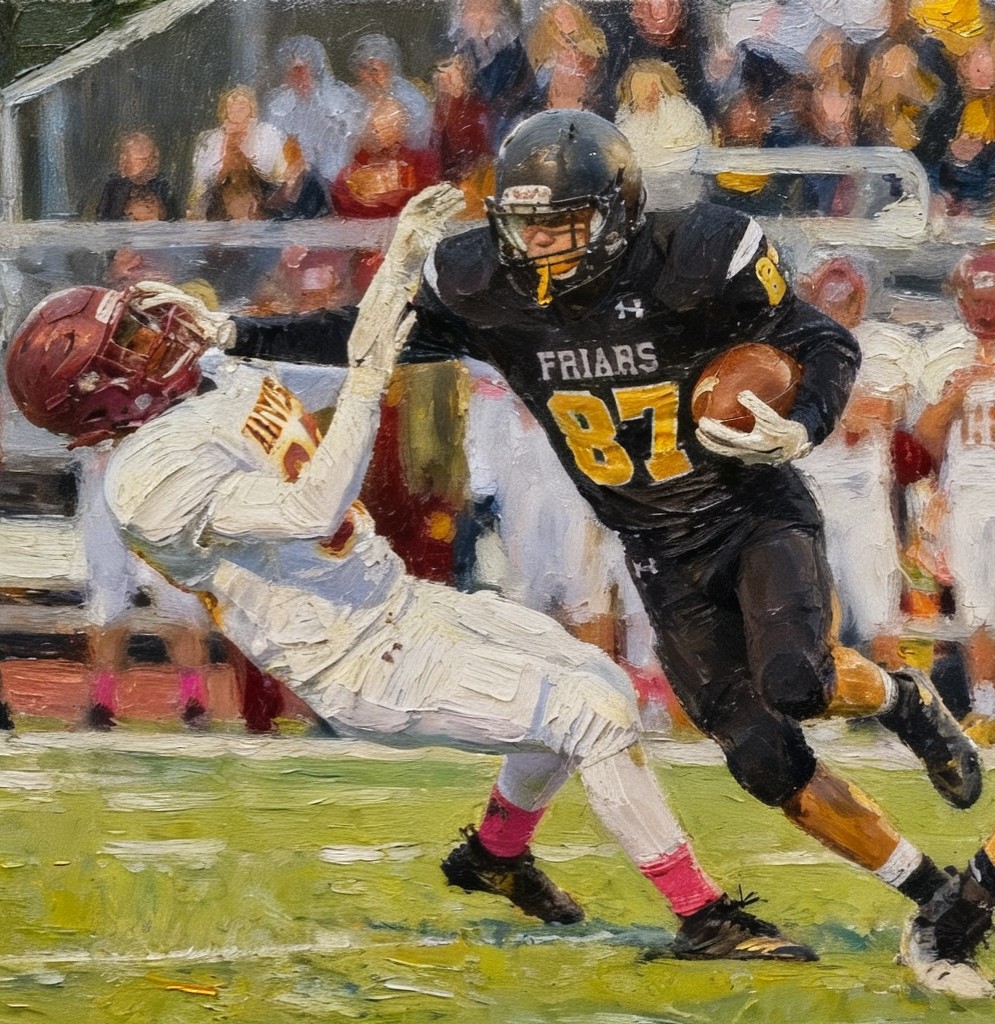
At that high school, I completely lost any desire for academic performance and played ice hockey, football, and lacrosse. I ended up going to summer school for math (the passing grade was higher at said private school, but still, I failed math as a freshman). Then I did so again. At the end of my senior year, deciding against playing junior hockey, I enrolled at the University of Alabama for the coming year, knowing I’d never need to touch math again in my life (thank God). I ended up starting that summer with another two weeks in summer school. Shortly before leaving to go back to Alabama and presumably have an amazing four years of partying and debauchery, I was home in NY when I got into a really bad car accident. This forced me to drop out of Bama a week after school started, and as a last resort I enrolled at St. John’s University in Queens (still as a Legal Studies major). I tried my best to come back, starting two weeks behind, and I made it to late October when I finally had to stop and address my health—taking a health-related leave and withdrawing from all my classes that semester. I’ll spare you any sob stories and just say pain sucks. Especially for someone who’d spent years with hours of physical activity every day and was now isolated and home from college with only the medication and lots of pain. I came back again to start that second semester, and the pain (medication) finally caught up to me. Again, I had to drop every single class, but I did it one by one until there were only two remaining in early April that I was willing to pay full price for just to keep myself sane and be in school until I couldn’t.
This is the period of my life where I did a lot of soul searching (there’s a lot more that I’m not saying here; I’m not a criminal, don’t worry employers—there’s just a fine line between life story and background leading up to where we’re going). I couldn’t go back and choose to play hockey instead of have fun, and now I couldn’t play any sport. I was a full year behind, and despite a job at a Jaguar Land Rover dealership, I was dealing with a lot of loss at the same time. I was losing people who’d occupied substantial roles in my life, the ability to have a normal social college experience, and the version of life I’d expected after high school. This is when I remembered that I did still have one asset, even if I hadn’t used it as much in the last four years. I’d always taken my brain for granted. Growing up with ASD, the environment wasn’t always nurturing to someone “nerdy,” so I became as stereotypically athletic as you could be. Once I realized it was all I had left, I began reading again, which I hadn’t done much of during high school. I left St. Anthony’s with a 90 GPA flat somehow, didn’t take the SAT or ACT, and I have no recollection of applying to college; my mom or some of the amazing girlies in my life likely helped with that.
Back to that second semester at St. John’s: sometime toward the beginning of that semester, when it became obvious I’d have to drop a few classes, I discovered a book called My Life as a Quant by Emmanuel Derman, and shortly thereafter read his other book Models Behaving Badly (insert crude 2000s trader joke that would rightfully get me cancelled in 2026). These books piqued my interest in finance, not because I thought I could fall back on my dad—the same guy who cut me from two sports teams and called me damaged goods to my face, by the way. Quantitative finance, and specifically algorithmic trading, intrigued me because they were different from the traditional finance I was accustomed to. Sure, I’d been buying unhedged 0DTE call and put options since I was 16 (don’t ask how, thanks Robinhood). Sure, I remembered a few times I did really well even before the pandemic, but I didn’t understand then how lucky I got buying calls on Ford and actually getting a move that wasn’t expected and didn’t entail theta decay. But I wanted to learn, and I spent my time devouring anything and everything I could find. Not just finance-related material—I have always loved learning for the sake of learning. Knowing what you don’t know has a way of making you feel less intelligent—a feeling I’d craved since I was a kid who scored high on some test that admitted me to STEM school.
By late February, I got a stroke of luck (this is the only time I’ll admit some nepotism was involved). A family friend, against my father’s wishes, got word that I was both extremely interested in finance all of a sudden and kind of devastated not being in school or having anything to do the following summer after the dealership got new management and I couldn’t do what they asked schedule-wise. So he asked if I wanted to shadow him for a few days at a mid-sized bank. I obliged gratefully, and that opportunity turned into two months of learning institutional fixed income from someone I was more willing to hear explain it than my father. Luckily for me, I was able to leverage that opportunity into a similar experience for the following two months learning private banking from an acquaintance of that family friend. With both of those on my résumé (despite not having a college transcript), I applied to the firm my father had just arrived at. It was much smaller—and note that I said firm, not bank, for the first time in his illustrious career. After the proper disclosures and a brief investigation confirming that my dad hadn’t interfered—which was a great way to start his new job—I was allowed to remain as an intern that summer, and with my light class schedule to ease back into college the following fall, I was able to stay part-time through December.
When I returned to school that fall, with my newly padded résumé, I was extremely motivated to change my major to finance with the renewed gratitude I had for being in school and learning formally. It was the first time I could remember wanting to take higher education extremely seriously. So I recall going to the dean of St. John’s college and sharing my excitement with him while inquiring how I could change from Legal Studies to Finance. Rather than tell me, he suggested I leave college altogether. Even aware of some of my struggles and the two health-related leaves, he said, “Not everyone is cut out for college.” I wasn’t looking for encouragement from him per se; I’d been through enough adversity that it didn’t hurt my feelings as much as it gave me even more motivation. After berating me over the grades I did have prior to dropping my classes the prior two semesters, he relented and I was released from his college with the ability to go to the Tobin School of Business (the finance school at St. John’s) and inquire about a finance major. Upon speaking with the deans at Tobin, they had a similar sentiment, telling me I should try business instead because finance is a Bachelor of Science and it would be too difficult; they didn’t feel comfortable admitting me. But there was one other option: the Department of Mathematics and Computer Science was considering adding a major the following year called Financial Mathematics, B.S., which was the combination of an Applied Mathematics and Finance degree. At the time, I figured that if I was in college—and I was grateful to be there as I was—I might as well LEARN SOMETHING. Translation: Why not take my historically worst subject? I’ve already had to drop two semesters; maybe if I can’t succeed at the challenge I think I want, then the dean was right and I’d leave college. But I still had one more hurdle: actually talking to the math department and finding out what I’d do in the meantime during the current year.
Although a bit intimidated and expecting the same rejection but worse, I still went to the Department of Mathematics and Computer Science. Once there, I met with two professors, Dr. Ostrovskii and Dr. Rosenthal, the former being the serving chair of the department when I visited. Unlike the heads of Legal Studies and the Finance major, they were more than willing to entertain the idea. They both spoke with me at length about mathematics in general, how I could finish taking my core classes, and how I could prepare for the official major program, which was still on the fence but where my interest, along with some other students’, was promising. Most importantly, though, I really attribute them—and later Dr. Catrina—to presenting mathematics to me in a way that allowed me to develop a deep passion for it in and of itself, separate from finance. After officially becoming an Applied Mathematics major, I felt both intimidated and ecstatic. I didn’t know what they saw in me, honestly, besides that passion and willingness to learn. I was brutally honest about my past in math and my initial interest in the subject being solely a result of the financial aspect. Around this time, I had been trading my own capital for over half a year and I began doing way better than I initially expected. I’d been trading futures (specifically ES and NQ), which I had become very familiar with during my time at the last firm. At that firm, I worked closely with the repo desk initially, which was interesting for learning about money markets and swaps. I wanted to get further away from my dad, though, so I transitioned to futures and commodities (I preferred equities anyway). A trader there was responsible for managing TWAP (Time-Weighted-Average-Price) and VWAP (Volume-Weighted-Average-Price) algorithms in commodities and equity futures markets, and his clients were external hedge funds. It was there that I became familiar with algorithmic trading and began developing and testing my own variants of these algorithms and similar automated execution strategies centered around liquidity imbalances (when I wasn’t helping the repo desk with its alphabet soup of ARMA, ARIMA, SARIMA, SARIMAX... models to forecast SOFR and LIBOR rates overnight). Eventually, I discovered an algorithm that, to my astonishment, actually worked (on certain time horizons with certain metrics derived the way I did them...). BUT the general idea was predicated on VWAP bands. Not the indicators day traders use—the 1.0, 1.5, 2.0 ... 3.0 standard deviations away from how I computed VWAP for a given contract based on data science. Sometimes we’d enter on a mean-reversion trade, sometimes continuation, and as I let the algo run and collected more and more tick data that included my derived metrics as well (I didn’t know the term feature engineering at this point), I began to optimize and focus more on the underlying market conditions (microstructure). As is customary, I gave the algorithm—really multiple algorithms in a pipeline, so “strategy” would be a better term—a cool name: TREmor, which stood for Trend / Mean Reversion. Eventually, I would like to post it to this site. The alpha degraded, and I fought for a long time trying anything and everything to see if it was still salvageable as a strategy, even revisiting it early this year out of curiosity. It was a relic of the Biden era; it appears to be more stable again—at least more stable than when I made the call to abandon it and spend my time on more promising algos in late 2024–early 2025 as the Trump regime took office and volatility was rampant earlier on. The reason I’d post it here is because even though I did find subsets of the model that are still consistently very profitable, and even feasible for long-term institutional buy-and-hold investors, I’m not comfortable having one or two big trades a week even if they are high probability. They don’t fit into my current portfolio of algorithms, which take double-digit trades daily. Plus, as I’ll touch on shortly, there’s not enough liquidity for me to trade them like I used to with the size I have now unless I committed to holding.
That was the first big win, and what led me to sit for the SIE and Series 31 as part of my futures-industry qualification and registration process. Back in school, Dr. Rosenthal had become the head of the Mathematics and Computer Science department and, because he had already been my advisor, he chose to retain me in that role for the rest of my time at St. John’s. He would go on to be an extremely positive influence and asset to me, as I went through every single mathematics class in my years there without getting below a 4.0 GPA (or a point off until Calc III). Had I not chosen spontaneously to attend St. John’s, I would never have become a mathematics major. I can say that straight up. Had they never proposed a Financial Mathematics major (which I had no knowledge of when I chose to attend), I again never would’ve become a mathematics major. And most importantly, had Dr. Rosenthal, Dr. Ostrovskii, Dr. Catrina, and Dr. Nikolaev not been there in the math department, I never would’ve been on the path I’m on now, doing research I love. I really don’t know where I’d be if that detour never happened; I certainly wouldn’t have had the fund and likely would never have received an undergraduate degree. So thanks to them, again.
From here (end of 2023) to early 2025, I don’t have much more to add educationally. As for the fund, it started by me allowing extended family and friends to open futures accounts that I could trade via my algorithms. The beauty of this structure was twofold: I didn’t have to worry about pooled assets—as a 19-year-old, that’s big—but most importantly I could trade however many accounts independently by copy-trading (having a select group of accounts all enter and exit at the same time). So four accounts of fifty thousand dollars could all make or lose one percent instead of a single two-hundred-thousand-dollar account. I’m not going to get into liquidity and execution strategies; you guys are smart. What I did figure out was how to split them correctly across tickers and even tabled with a sizeable amount of prop-firm accounts that have a major benefit the keen reader will pick up on, which, for a while, was an incredible structural source of alpha that I’d even say came from proper risk management. (Mark Spitznagel would be proud.) After a while, I developed more complex strategies and began implementing machine learning into my alpha-discovery pipeline, especially when it came to market microstructure and L2 depth-10 tick-data feature engineering. This is where I’m going to mute myself a little, but I will say I started really loving research itself. You can train an LGBM model and use SHAP to try making rules and portfolios of your features for certain strategies. But you usually have to define a metric—volatility or trade intensity, for example—and decide whether normalization is required, how much of a move over what amount of time or volume constitutes a liquidity imbalance, or any host of other phenomena I’ll hold off on discussing for now.
BUT you can also have a latent-state transformer model try LEARNING the best parameters (underlying market microstructure) before a probabilistic event occurs, instead of building the strategy first. The latter is harder to implement as described—if not impossible—with latency and slippage considerations. It could be valuable in alpha research, but it’s best suited for a research paper initially.
Those are the ideas I began focusing on toward the end of 2024, and by the first few months of 2025 I was ready to return a lot of the capital I’d acquired two years earlier. I felt at the time that the market was moving too irrationally, and I didn’t want to waste my time having kill switches for the MS events that would occur right before a news-driven surge or selloff. I would rather waste my time by doing research. Not to mention I had begun the master’s in finance fast-track program at St. John’s while finishing the mathematics classes in my undergrad (I finished the finance classes early and caught up entirely by overloading my schedule, taking summer classes and one winter intersession class every year). One final health scare was all it took for me to officially close the CTA portion of the fund to external capital while a family member retained the RIA and ability to manage other passive asset classes. For compliance purposes, the portion I oversee now functions more like a family office. Put formally: Coulter Capital Management is a quantitative investment firm founded by Nathaniel Coulter. The firm historically managed external capital through systematic futures and equity-derivatives strategies. Its current activities operate through a more limited private-capital structure, with Coulter continuing as founder and Chief Investment Officer while focusing primarily on quantitative research and systematic trading.
After dialing back my focus on trading, I took a more active role in a wealth-management position I’ve been failing to mention. But my main priority was research, and I became consumed in it all the way through graduation from St. John’s. After that, I applied to Mathematics of Finance and became a postgrad at Columbia, where I am now, mainly focused on school, although I trade based on compliance requirements and with less size than I used to. (Mostly just because I enjoy testing my research and remaining strategies as well as monitoring their performance.) Basically, I’ve slowly regained my passion for trading itself since I stopped focusing on the P&L and instead on the percentage increases or decreases, and how I can adjust my models and execution pipeline.
That is basically the story of how I ended up in finance, and even if you think it was destined from the start, it took all this for me to blaze my own trail. So I hope any aspiring students out there know that it doesn’t matter how you got here; it matters how you perform now that you’re here. The undertones of this story are a bit somber, and I’m hoping a lot of you made the assumptions without me having to say it... You have to sacrifice. Time. Energy. Money. I might not have had a choice at first. I didn’t have friends; I spent 16+ hours a day staring at a monitor and math equations, but I wouldn’t trade that for the world. Conservative estimate: 12 hours a day for 365 days is 4,380 hours; call it five years and that’s 21,900 hours doing this. My father has been in finance for over forty years now. He averages about the same and still gets up at 4:30 a.m. every day to take the train into NYC with the same hunger he’s always had. Say he’s spent 10 hours a day for 252 trading days a year: 2,520 hours annually × 40 years = 100,800 hours on the conservative side in front of a fucking Bloomberg terminal. That is your competition, but it’s not as bad as you think. In five years, I’m already at 21.72% of that time, and I’d argue my time has been optimized a little better in Quant anyway.
Remember: Motivation fades, Discipline is what remains. Maybe I am downplaying my STEM past a little; I objectively had a good intellectual starting point. That’s irrelevant; someone with slightly above-average intelligence who works hard will beat a gifted person who’s lazy. I don’t want to go on the whole IQ rant here; maybe I’ll do it another day. It’s not as set in stone as psychologists would have you believe. There is hard science on neuroplasticity. So just imagine: if you were someone with above-average intelligence and above-average work ethic... Or, for some of you reading this, you can be gifted or extremely gifted with an inhuman work ethic and discipline. Imagine how much you could accomplish with that combination…
Why do you still want to be in finance?
— Nate
Manually Control your Browser Fingerprint: Enhance your Browser Privacy, and Create Stealthy Virtual Machines with advanced canvas control, and system-level transparency. Obscura: Chrome Extension allowing you to deliberately align your environment with standard browser characteristics—no tracking, no randomness, just consistency. SEE FULL DESCRIPTION FOR A BONUS OPSEC GUIDE! (Scroll to the bottom).
 Download on GitHub

💡 Manually Control your Browser Fingerprint: Enhance your Browser Privacy, and Create Stealthy Virtual Machines with advanced canvas control, and system-level transparency. Obscura helps reduce data leaks by allowing you to deliberately align your environment with standard browser characteristics—no tracking, no randomness, just consistency.


Obscura: Canvas Uniformity is a Chrome Extension and browser fingerprint hardening tool focused on deterministic fingerprint spoofing, not randomization. Unlike most canvas privacy tools—which rely on canvas poisoning (randomizing values per session or per site)—Obscura enforces a uniform and stable fingerprint across sessions, devices, and domains. In other words, unlike most anti-fingerprinting tools that aim for evasion through noise. Obscura aims for camouflage through control.
Canvas Poisoning (e.g., Brave Browser, Tor Browser) works by introducing entropy into the fingerprint surface. This is valuable for pure privacy because it prevents tracking across sessions.
Canvas Uniformity, works by spoofing canvas output with fixed, user-defined values, ensuring your fingerprint looks consistent and deliberate, but never real.
🛡️ You can appear as a stable identity, not a chaotic or rotating one
🎯 Ideal for Red Team simulations, bot development, penetration testing, or controlled fingerprint spoofing
👤 Still useful for privacy, especially if you want to impersonate a common browser profile rather than stand out as “random”
Obscura injects JavaScript into every page context, using browser APIs like getImageData(), toDataURL(), and getContext() to override and spoof the outputs of HTML canvas rendering. Your configuration (set via config.html) determines how canvas fingerprinting attempts are handled. Injected values are deterministic (defined by you). Obscura ensures the spoof is applied before page scripts execute.

CSP-bypass.js (Chrome Security Policy) enables inject.js to successfully inject on 95% of websites. While chromelaunch2.bat blocks WebRTC so your real PC specs, and IP don't leak.
📛 Masks canvas getImageData() and toDataURL() output
⚙️ Offers full control through a local config panel
🧱 Optional CSP bypass for locked-down environments
🧪 Designed for privacy lab testing, pen testing, and educational use
⇒ Obscura automatically detects your current IP, OS, Resolution, CPU Cores, RAM, and Chrome Version for your convenience, and safety!
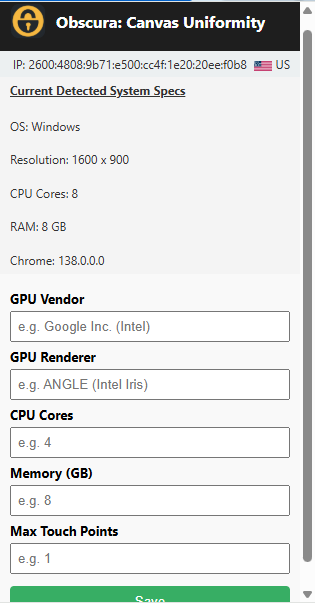
To install Obscura in Chrome or any Chromium-based browser:
Step 1: Download the repository ZIP file here: https://github.com/Nathaniel-Coulter/Obscura-Canvas-Uniformity/raw/main/Obscura-Chrome.zip (Then click the on the arrow and select “Download ZIP” , if isn't downloaded automatically.)
Step 2: Extract the ZIP Unzip the contents into a folder on your desktop or another easy-to-access location. (Left Click -> Extract)
Step 3: Open Chrome and navigate to chrome://extensions/ or Click the little Puzzle Piece to the right of your address bar, than click manage extensions. (You can also click the menu icon → Extensions.) Enable Developer Mode Toggle the Developer mode switch in the top right corner of the extensions page. Then click “Load Unpacked” and select the folder where you extracted Obscura.zip.
✅ Obscura should now appear in your extensions list and begin functioning automatically.
To Download Via PowerShell, CMD, MacOS or Linux Terminal:
wget https://github.com/Nathaniel-Coulter/Obscura-Canvas-Uniformity/raw/main/Obscura-Chrome.zip

                        curl -LO https://github.com/Nathaniel-Coulter/Obscura-Canvas-Uniformity/raw/main/Obscura-Chrome.zip

                        Invoke-WebRequest -Uri "https://github.com/Nathaniel-Coulter/Obscura-Canvas-Uniformity/raw/main/Obscura-Chrome.zip" -OutFile "Obscura-Chrome.zip"

                        powershell -Command "Invoke-WebRequest -Uri 'https://github.com/Nathaniel-Coulter/Obscura-Canvas-Uniformity/raw/main/Obscura-Chrome.zip' -OutFile 'Obscura-Chrome.zip'"
Note: No dependencies are required to start spoofing. To customize behavior, use the built-in config panel (see next section).
To get the full benefits, it’s important to launch Chrome in a way that supports spoofed User-Agent, window size, and network stack behavior.
🧭 Launch Chrome with Spoof Flags
Included in this repo is a Windows batch script named: chromelaunch2.bat. This launches Chrome with a custom User-Agent string and other privacy flags. These flags help simulate a full browser fingerprint and suppress real system data that might override your spoofed inputs.
📦 Launch Script Contents:
@echo off
                        REM === Launch Chrome with spoofed fingerprint parameters ===
                        start chrome.exe ^
                          --user-agent="Mozilla/5.0 (Windows NT 10.0; Win64; x64) AppleWebKit/537.36 (KHTML, like Gecko) Chrome/138.0.7204.98 Safari/537.36" ^
                          --lang="en-US,en;q=0.9" ^
                          --window-size=1440,900 ^
                          --disable-webrtc ^
                          --disable-accelerated-2d-canvas ^
                          --disable-background-networking ^
                          --disable-background-timer-throttling ^
                          --disable-client-side-phishing-detection ^
                          --disable-hang-monitor ^
                          --disable-popup-blocking ^
                          --disable-default-apps ^
                          --no-default-browser-check ^
--no-first-runUse applelaunch.sh & linuxlaunch.sh instead of chromelaunch2.bat to run Chrome.
linuxlaunch.sh for Linux
If your system uses chromium instead of google-chrome, replace the first line
#!/bin/bash

                        # === Launch Chrome or Chromium with spoofed fingerprint parameters ===
                        google-chrome \
                          --user-agent="Mozilla/5.0 (Windows NT 10.0; Win64; x64) AppleWebKit/537.36 (KHTML, like Gecko) Chrome/138.0.7204.98 Safari/537.36" \
                          --lang="en-US,en;q=0.9" \
                          --window-size=1440,900 \
                          --disable-webrtc \
                          --disable-accelerated-2d-canvas \
                          --disable-background-networking \
                          --disable-background-timer-throttling \
                          --disable-client-side-phishing-detection \
                          --disable-hang-monitor \
                          --disable-popup-blocking \
                          --disable-default-apps \
                          --no-default-browser-check \
                          --no-first-run
Launch Script:
./linuxlaunch.shapplelaunch.sh for macOS
Make sure the path to Chrome is correct (I used the default for macOS).
#!/bin/bash

                        # === Launch Chrome with spoofed fingerprint parameters ===
                        "/Applications/Google Chrome.app/Contents/MacOS/Google Chrome" \
                          --user-agent="Mozilla/5.0 (Windows NT 10.0; Win64; x64) AppleWebKit/537.36 (KHTML, like Gecko) Chrome/138.0.7204.98 Safari/537.36" \
                          --lang="en-US,en;q=0.9" \
                          --window-size=1440,900 \
                          --disable-webrtc \
                          --disable-accelerated-2d-canvas \
                          --disable-background-networking \
                          --disable-background-timer-throttling \
                          --disable-client-side-phishing-detection \
                          --disable-hang-monitor \
                          --disable-popup-blocking \
                          --disable-default-apps \
                          --no-default-browser-check \
                          --no-first-run
Launch Script:
./applelaunch.sh🧠 (IMPORTANT) While the built in scripts will detect some specs, that feature is mostly for your convenience and not to validate your setup.
This extension mainly aims to spoof 8 values:
-User Agent
-Language
-Window Size/Resolution (Height and Width)
-GPU Vendor (aka WebGL Vendor)
-GPU Renderer (aka WebGL Renderer)
-CPU Cores
-Memory (GB)
-Max Touch Points
(The Bat file handles the first three, and the extension itself handles the remaining five. See Config Recomendations.txt for copy paste examples for the extension.)
⚠️ Batch File: ⚠️
I personally recommend using the most recent version of Chrome for your OS, which are the following as of July 8, 2025...
138.0.7204.98 for Windows
138.0.7204.94 for macOS
138.0.7204.100 for Linux
However, if your goal is to blend in;
1.) Visit https://amiunique.org
2.) Click “See my fingerprint”
3.) Scroll down → Click “Global Statistics”
4.) Choose a recent timeframe (last 15–30 days)
5.) Under “Web Browser” click the hamburger menu (☰) → View Data Table
6.) Copy User-Agent, GPU, and other popular specs from high-traffic entries
💯 This gives you realistic input values to copy into Obscura’s configuration panel as it will show you which (Chrome) Version the majority of site visitors were using during the given timeframe.
** The following inputs are EXTREMELY important if your browser exists on a Virtual Machine or Qube like mine.** As the typical Virtio & Swift graphics drivers, paired with low CPU and Memory specs are the tell tale signs of a Virtual Machine!
👉 GPU Vendor: Google Inc. (Intel)
I suggest using "Google Inc. (Google)". Make sure your GPU Vendor and and Renderer are typed correctly so they match other users.
👉 GPU Renderer: ANGLE (Intel, Intel(R) Iris(R) Xe Graphics (0x00009A49) Direct3D11 vs_5_0 ps_5_0, D3D11)
If you aren't running Obscura on a Virtual Machine and your similarity ratio on amiunique is high, meaning you don't have a unique GPU Renderer, than you can consider leaving this field blank. If you want to impersonate another machine, visit chrome://gpu for exact Specs to copy. Or Google the specific specs of another machine.
👉 CPU Cores: 8
👉 Memory (GB): 16
If you are using Obscura on your native OS, and/or have normal hardware specs, i.e, 8 Cores, 16GB of Ram -- then you're probably okay.
NOTE: By "Cores" to allocate, I mean vCPUs. Websites can't see what hardware you're running, as they are blocked from running commands on your terminal. This means they can only estimate your hardware based on your drivers, and other leaks we addressed via the batch file... So even if you have an older i5 chip or equivalent with 6-10 physical cores, it should support dual threads so 6*2=12 VCPU's. If you can get by without using the extension by allocating more vCPU "cores" to your VM, that is always the best option.
However, if you're running a VM without the ability to allocate a minimum of 4 Cores and 8GB, definitely use the inputs below. (I still HIGHLY recommend getting an SSD / Qubes so you have the ability to allocate normal looking resources to your VM for Redteam sims or just everyday use without getting flagged by Banking sites). Your system's memory isn't the biggest concern but know that some sites can see how much remaining space you have on your drive. Most are not that agressive, and have no need to be that invasive however.
Suggestion: Only deviate from suggested specs unless you're aiming to spoof a certain machine, otherwise your browser fingerprint will be too unique if you put like 7 cores and 15GB of RAM it isn't realistic anymore.
👉 Max Touch Points:
-Set as 0 or leave blank for most Standard Desktops.
-Set as 1 for Touch Screen Laptops.
-Set as 5+ for Mobile Device Spoofing (Advanced).
👉 Spoof Audio & Fonts Optional — Disables AudioContext fingerprinting (set to false by default along with fonts since version 4.1 as they began to get flagged and I found it easier to just use the Bat for fonts, or download them -- and leaving audio unspoofed since any similarity ratio that isn't 0.00 will do). I did leave the code though in case you can't use Batch files, and you don't have a windows license. For those fringe cases you can tweak config.html and popup.js to readd the ability to toggle spoofs on.
Example Configuration: Base i5 Lenovo ThinkPad (2020)
{
                          "userAgent": "Mozilla/5.0 (Windows NT 10.0; Win64; x64) AppleWebKit/537.36 (KHTML, like Gecko) Chrome/138.0.7204.98 Safari/537.36",
                          "gpuVendor": "Google Inc.",
                          "gpuRenderer": "ANGLE (Intel, Intel(R) UHD Graphics 620 Direct3D11 vs_5_0 ps_5_0)",
                          "hardwareConcurrency": 4,
                          "deviceMemory": 8,
                          "maxTouchPoints": 1,
                          "spoofAudio": false
                        }
❗❗❗Final Config Tips:❗❗❗
1.) If your VM can’t allocate at least 4 CPU cores and 8GB RAM, use those values anyway in Obscura — but understand that some fingerprinting tools may still detect hardware inconsistencies between your browser (which is spoofed), and what they can estimate from your base OS.❗❗❗
2.) GPU Renderer: If your similarity ratio is high (i.e., many people have your renderer), you may choose to leave it blank to simulate ambiguity. (See start of next section)
3.) Copy and Paste; Obscura will inject exactly what you tell it to. Make sure there's no typo's.
‼️AmIunique.org isn't perfect
The data you're being compared against is everyone who's visited the site in the given timeframe you're viewing. For that reason, note that just because a similarity score for your user agent (Chrome Version) is lower than another version, that doesn't neccesarily make it less legitimate. If you're using the latest stable release, you have to account for the lag in user adoption. So try changing the time period to today / this week.
On the otherhand, if you have a high similarity score for WebGL Vendor or WebGL Renderer. But you're on a Virtual Machine... That's actually a bad thing. You aren't blending into the target segment of internet users -- Don't misinterpret the data, you're blending in with bots so you should still inject a driver that doesn't reflect the usage of a VM or headless browser.
Once you’ve installed and configured Obscura, it’s important to validate your fingerprint, check for leaks, and ensure your setup is trusted. Here’s a comprehensive guide to do exactly that.
✅ Validate Your Fingerprint Use the following tools:
🔎 AmIUnique.org — Check canvas spoofing & compare similarity ratios
🖼️ BrowserLeaks.com (Canvas Test) — Detect canvas tampering
🚰 Dnsleaktest.com — Additional resource for WebRTC and DNS (Domain Name System) validation
🔬 Pixelscan.net — Advanced fingerprint scanner with tracker detection (Pass or Fail test detects headless browser or webscraping bot similarity).
📡 Whoer.net — Displays IP, proxy/vpn status, DNS, and WebRTC leak status
🔐 Fingerprint Hygiene Checklist
🛡️ Use Obscura with realistic fingerprint values (canvas, GPU, UA, memory, etc.)
🧱 Block WebRTC to prevent real IP leakage (handled in chromelaunch2.bat)
🧭 Use a trustworthy residential proxy, not a VPN — VPNs are fingerprinted easily. (You could use a sys-VPN routed Appvm on Qubes and use Proxifier to connect to the Socks5 on your Windows iso. See Qubes section for more).
📛 Avoid DNS leaks by routing all DNS traffic through your proxy or system-level firewall
🔁 Keep your spoofed values consistent across sessions to avoid standing out
🏠 Use Residential Proxies — Not VPNs Why not a VPN? VPN IPs are often flagged, associated with datacenters, and shared by thousands of users. This raises red flags for anti-fraud systems and breaks your OPSEC model.
Recommended Networking Approach: Use a residential or mobile proxy (e.g., SmartProxy (Decodo), IPRoyal, Oxylabs) that provides: Sticky sessions, Custom IP rotation, ISP-level trustworthiness
(Check IP trustworthiness with sites https://getipintel.net/ or https://www.maxmind.com/en/request-service-trial?service_minfraud=1)
These give you the cleanest spoofed profile when paired with Obscura.
VPN's don't do anything to protect against DNS / WebRTC leaks. I wouldn't even use one with Tor unless it was to hide my activity from an ISP (Internet Service Provider). Even then you could just use a Tor Bridge.
Browsers will leak both even if you manually disable them in a given browsers settings. Yes, even Brave and especially chrome. Firefox is safer to an extent. But your DNS + WebRTC can still leak your real IP. All you're doing is hiding traffic from your ISP.(Tails won't save you either even with JS disabled -- I still love Tails for Electrum & Cold Wallets though❤️). My personal recommendation for anyone who wants to be as OPSEC conscious as possible is to use Qubes OS on an SSD you can connect via lightning port. https://www.qubes-os.org/
Here's a breif overview of my Qubes OS setup:
1️⃣ Main qube: Windows10 iso (extremely hardened with extensions like Obscura, additional WebRtc + DNS blocking apps, fucktelemetry.cmd (https://gist.github.com/FadeMind/9500d49948654b50aa870706a8ac9f04), manually disabled IPv6 in Network & Ethernet settings so I can only allow IPv4 traffic out, and Proxifier.)
Proxifier allows you to route all traffic through a dedicated Proxy, and does a really good job ensuring no leaks if you configure rules correctly.
^I don't have that qube connected to my home wifi. All networking is routed through another StandaloneVM (Qube) ->
2️⃣ Proxy Qube (Sys-proxy): I previously built a Void-Linux template, although I now use Gentoo-Minimal (community template) because of missing dependencies and Qubes compatibility trouble. This qube uses tun2socks, redsocks, and IP Tables to catch as much traffic as possible leaving win10 and route it all through a socks5 provider. Redsocks & iptables configured to block anything else from leaving if it's not routed through the Socks5. This is a step up from just using Proxifier inside your windows qube, but its well worth it if you have the time and willingness to setup. You know exactly what comes in and out of your Qube.
All networking routed through ->
3️⃣ Firewall VM: I chose Alpine Linux for this Appvm (iso not template) because it's super lightweight, minimal attack surface, and you can control everything that comes in or out since you pretty much have to allow, and build all networking compatibilities / dependency packages with qubes in 2025. This Qube serves as a final attempt to stop anything from leaving the chain. Basically, copies and builds upon the firewall in proxy VM just stricter, and serves a few other purposes like MAC Address spoofing.
MAC Address Spoofing isn't usually needed in Qubes because only your net-vm "touches" physical hardware like your router or modem. The reason I have Firewall VM coded to spoof it on start, is because I use Qubes from networks other than my home wifi occassionally. Hotels, Office, School... Even though your AppVM's have their MAC addresses abstracted as a result of compartmentalization, and their networking being routed from net-vm downstream... it's still feasible that your net-vm could get tracked. (That's partially why I have the next VM where it is in the chains order. To serve as a "bottom up buffer" against Kali users & wifi networks I'm not in control of). 💀
All networking routed through ->
4️⃣ VPN VM (Sys-Mullvad): Debian minimal template, very basic setup. I use Mullvad VPN, but this is more to obscure ISP traffic, and make it so no traffic from my windows machine ever touches my actual wifi. I usually keep the same IP address for a few days, and i'll hardcode IPtables + redsocks firewalls to only allow traffic leaks from that IP. But I don't always have it chained when i'm home or doing normal browsing on a personal-vm. Since I boot qubes from an SSD, it's nice having a dedicated VPN qube to be used on public networks, as a good first machine for the network to connect to. Also, I use Mullvad as a VPN and VPS provider because I trust them with my data. The Swedish police raided them a few years ago, and left with nothing because Mullvad themselves doesn't keep logs. 😂😆🤣 Not to mention they are priced amazingly, and quite easy to setup using WireGuard on a bare Standalone VM like Debian Minimal.
5️⃣ Sys-net: This is just a normal network VM like how you'd connect to the internet on a normal operating system. Template = (Fedora-41).
In sum — your first machine doesn't have to be a Windows10 machine. I also have a few other ISO's that I connect to this chain depending on use cases; like Parrot, BlackArch or Kali (if you're a 15yr old MentalOutlaw viewer).
‣background.js - Core extension script handling background injection and runtime behavior.
‣inject.js - Injected into web pages to override canvas fingerprinting APIs.
‣popup.js - Handles popup logic
‣config.html - Configuration panel for customizing spoof values manifest.json Chrome extension manifest (v3) declaring permissions and scripts.
‣CSP-bypass.js - Additional script to inject spoofing code even on CSP-protected sites.
‣chromelaunch2.bat - Batch script for launching Chrome with spoofed fingerprint flags.
‣Config Recommendations.txt - Original notes for tuning spoof values — content integrated into README.
icon16.png, icon32.png, icon48.png, icon128.png are just icons used by the extension in different browser views logo.png, mdheader.png Branding assets used in README and UI Readme.Rmd RMarkdown source file for generating the README Readme.md Final GitHub-rendered README document.
This project is licensed under the MIT License — see the LICENSE file for full terms.
NateBot 🤖 - Real-Time Chess Complexity & Tension (λ₁) Analyzer: NateBot is an interactive chess trainer focused on understanding positions, not memorizing lines. It introduces the first practical, real-time implementation of λ₁ Strategic Tension; a graph-theoretic metric of positional complexity derived from combinatorical research.
Download on GitHub
NateBot is an interactive chess training system focused on understanding positions rather than memorizing lines.
It introduces the first practical, real-time implementation of (λ1) Strategic Tension — a graph-theoretic metric of positional complexity derived from combinatorial research and integrated with modern computational analysis.
The project aims to augment human decision-making by translating abstract structural complexity into actionable, quantitative signals during play.
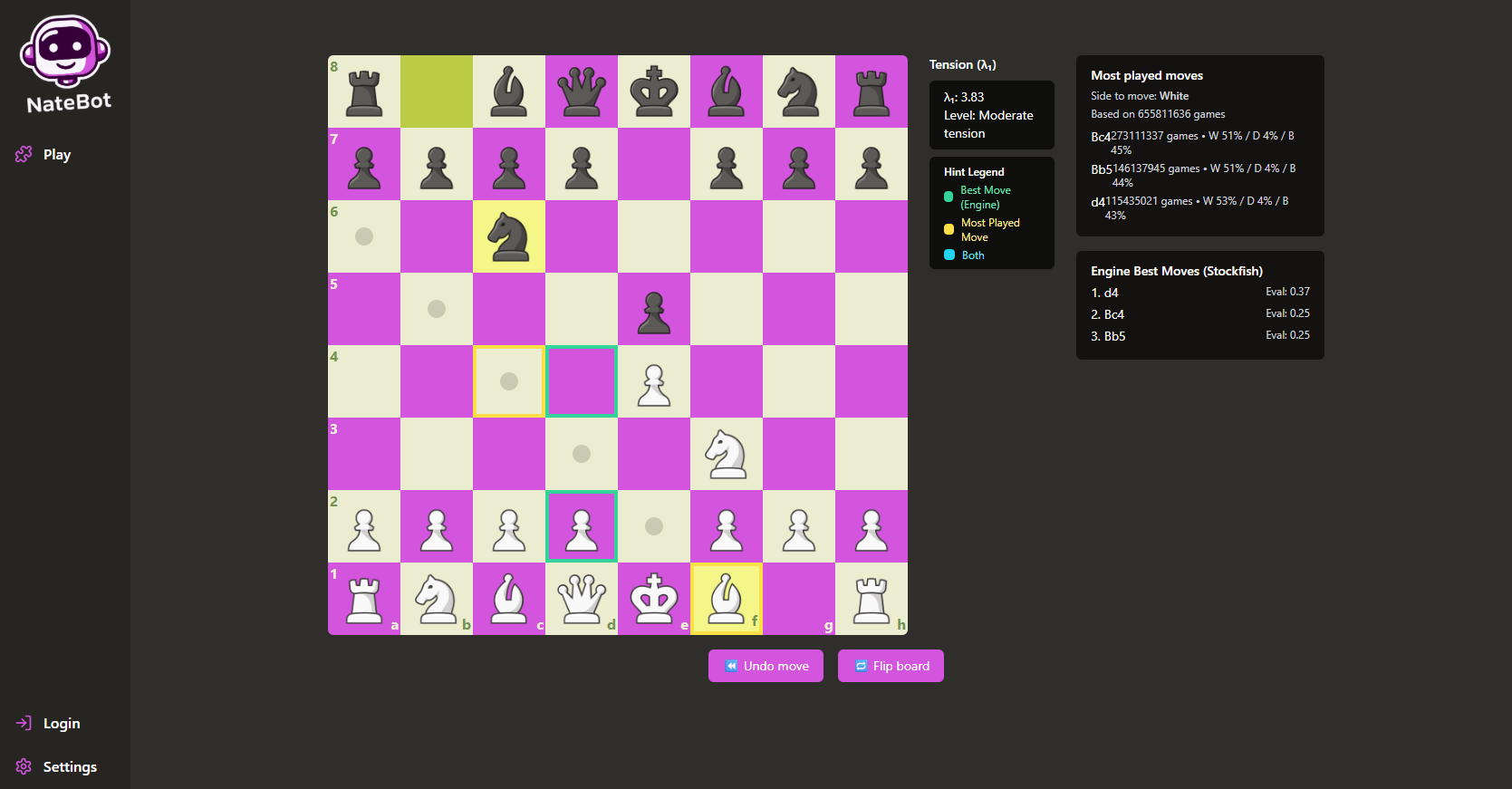
Empirical and theoretical insights reveal a fundamental divergence between human cognition and engine optimization:
This asymmetry explains:
NateBot exposes this hidden structural layer in real time.

Properties:
Where λ1 is the largest eigenvalue of the adjacency matrix, computed live after every move.
Designed for experimentation, intuition-building, and structural learning.
(Note: Parser is Built in)
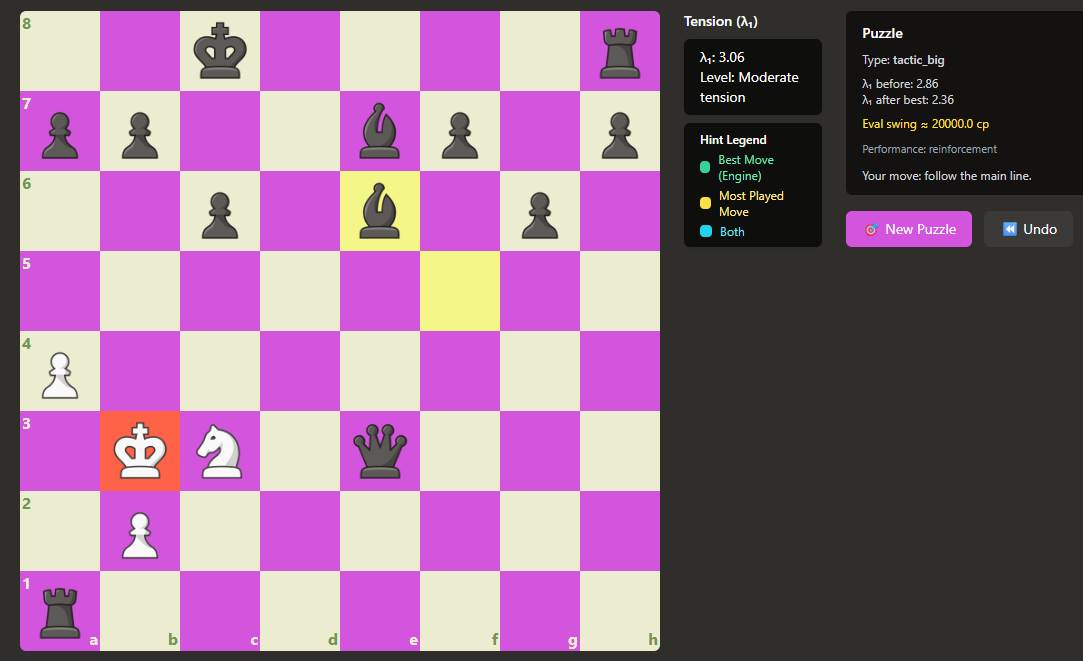
NateBot is not about replacing intuition — it is about making intuition legible.
By exposing the spectral structure of positions, the system bridges:
into a single, interpretable training environment.
A working map of alpha models, data sources, trading algorithms, feature-engineering notes, and retired systems whose original edge may have decayed but whose structure remains useful. [Coming Soon...]
Community involvement, charitable work, education, and selected initiatives supported through personal and Coulter Capital resources.
Although my about section no longer states it, I love learning. Learning for the betterment of yourself, or simply for the joy of solving problems. Anyone who knows me will tell you I’m prone to getting into technical conversations with strangers (usually about their profession or field of study). However, when I’m not asking questions—I also have a tendency to over-explain dense topics to anyone who’ll listen.
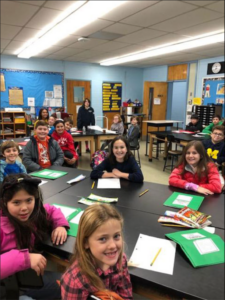
So it should be no surprise to anyone that I truly believe that nurturing curiosity through hands-on experience from positive role models is paramount in the development of academic passion. I myself was a student of Jack Abrams in 2013, and I would attribute my passion for challenges and problem solving to it—traits that ultimately led to me choosing STEM-field undergraduate degrees and now postgraduate study.
I attribute my love for learning to having attended this STEM school prior to high school. I also believe that nurturing a passion for education is the most important factor in raising and developing children.
Having the opportunity to share my passion for STEM topics with children aged 5–6 through teaching them, offering advice, and personally being the one tasked with quenching their insatiable curiosities will always mean the world to me. Giving back through education is both the ultimate gift and one of the greatest honors for me.
Always an amazing night. From an early age, I always appreciated the significance of volunteering for this event. Over the almost ten years I’ve been a part of Buddy Skate, the children I’ve met are always the most positive and mature humans you could ever meet.
For those who don’t know, Buddy Skate centers around teaching and assisting terminally ill and/or mentally disabled children how to ice skate. Because a volunteer is typically holding their “buddy” up from falling the entire time, you get to develop a significant relationship over the next couple hours.
Every year I think back and wonder how some of my past buddies fared with their treatments. Regardless, the children are always the most positive and happiest people you could meet despite their circumstances, and that is something that I recall as exemplifying the human spirit. I think we could all learn from them.
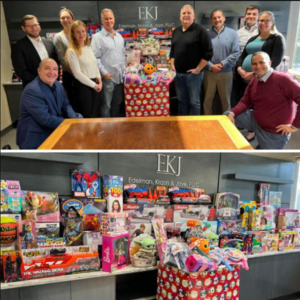
The John Theissen Children’s Foundation is truly one of the best charities I’ve had the privilege of participating in. Visiting terminally ill children in the hospital and seeing their reactions to the gifts is one of the most special feelings I have ever felt. My father has been participating in the event since I can remember, and it’s amazing to see how far it’s come from one man with a big heart to NY Islanders and Citigroup / other large financial institutions on the list of donors.
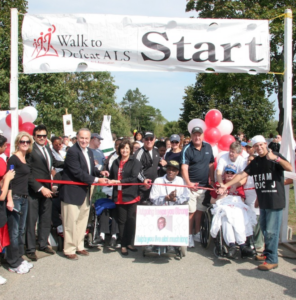
Tasked with promoting the event to everyone in my program and coordinating logistics. As coordinator, I promoted the Walk to Defeat ALS within my program and organized logistics for our team. Unlike many service experiences that carry a more solemn tone, this event stood out as uplifting and energizing.
The setup was simple: secure sponsors, then complete as many laps as possible to raise donations. What made it truly special was the chance to rally together and feel like we were directly competing against a disease, rather than just easing its effects. My teammates and I approached it with the same excitement and intensity we’d bring to a big game, turning support into a spirited collective effort.
This event is a fun one. In every other charity I’ve mentioned involving diseases, you, as the volunteer, are humbled. As someone who would rather suffer than see someone else in pain, those early years of the Buddy Skate are especially solemn thoughts on the car ride home.
My volunteer work at WellLife Network profoundly shaped my perspective on empathy, accountability, and resilience. Having faced personal challenges with mental health, I developed a deeper understanding of the struggles others face and the strength it takes to overcome them.
Working with older individuals who were former addicts, ex-offenders, and those living with mental illness gave me some of the most eye-opening conversations of my life. Many demonstrated remarkable courage in rebuilding their lives, taking ownership of their past, and striving to move forward with positivity.
The two qualities that stood out most in these individuals were accountability and gratitude; traits that, when combined with conscientiousness and openness to learning, form a powerful foundation for change. This experience reinforced for me that it is never too late to change course and that resilience can be one of the strongest forms of character.
The Make-A-Wish Foundation is a remarkable organization that brings joy and hope to children facing life-threatening illnesses. While the cause is inherently emotional, I’ve found the greatest impact comes from visiting terminally ill children in hospitals.
Despite their challenges, these children often display an inspiring perspective on life, marked by gratitude, resilience, and optimism well beyond their years. Witnessing that has been profoundly moving and has reinforced for me the importance of empathy and giving back.
Restoration of the bike lane at Kissena Park in accordance with St. John’s University, November 12–13, 2025.
20+ hours of community service from May 2023–June 2023 at an underprivileged church in my area.
Growing up, my father has always coached my hockey teams throughout high school. This experience has given me a detailed perspective on the subject of favoritism, having been privy to the politics of other coaches’ relationships with their children while simultaneously witnessing its reception by teammates and their parents. Unlike most coaches’ children, I never wanted or needed my father to coach me. He was always asked to help because of the value he brought to an organization.
As a result of our shared disdain for politics, he would only ever involve himself after I tried out and made a team on my own merits. For these reasons, we have always maintained a very professional relationship in any environment with a power hierarchy. I always called him coach and was treated the same as my teammates. We would always separate ourselves in that he never directly coached the position I played, to establish a meritocracy by eliminating any perceptions of favoritism. I preferred to ensure the time I played was an earned reflection of my own work ethic.
My high school has always had a strict policy against parent coaching. However, because everyone involved—coaches, players, and parents—knew how professionally we operated, he was allowed to coach. People still reach out to express their gratitude and respect for how fairly we operated.
For all these reasons, and because I had a grandfather who spent his life in the military, developing strong, moral, disciplined, and smart young men means a lot to me. In hopes of accomplishing that, and also as a thank you to the organization that made an exception for my father as a coach, I wanted to give back and show younger boys how to act professionally and non-politically as well.
I hold the somewhat traditional opinion that doing manual labor builds character. Helping keep the garden in order, buying and planting vegetable trees for the underprivileged community members who have no property of their own to plant on (living in apartments), and eating the vegetables they grow will definitely give most middle-class Americans a sense of gratitude.
Finally, being fortunate enough to afford two snowblowers, I will go clean up their sidewalk and garden in the winter for the kids to play on.
It’s equally as much of an exercise for the body as it is for the heart.
Science and Technology · Education · Veteran Support · Poverty Alleviation · Children · Animal Welfare · Arts and Culture · Civil Rights and Social Action · Economic Empowerment · Environment · Health · Human Rights · Social Services · Disaster and Humanitarian Relief
Historical records, photographs, media, and earlier work.